What Does SYBAU Meaning in Text? The Real Meaning, Tone & When to Use I
If you’ve recently come across “SYBAU” in a message, there’s a good chance it caught you off guard. It’s not one of those harmless, everyday abbreviations—it carries a strong tone, and depending on context, it can feel either funny or surprisingly harsh.
People search for “what does SYBAU meaning in text” because the acronym isn’t immediately obvious, and more importantly, it can be risky to misunderstand. Replying the wrong way could turn a light conversation awkward—or escalate tension without meaning to.
This guide breaks it down in a clear, human way. You’ll learn what SYBAU actually means, how people use it in real conversations, and how to handle it confidently without misreading the tone.
SYBAU Meaning in Text – Quick Meaning
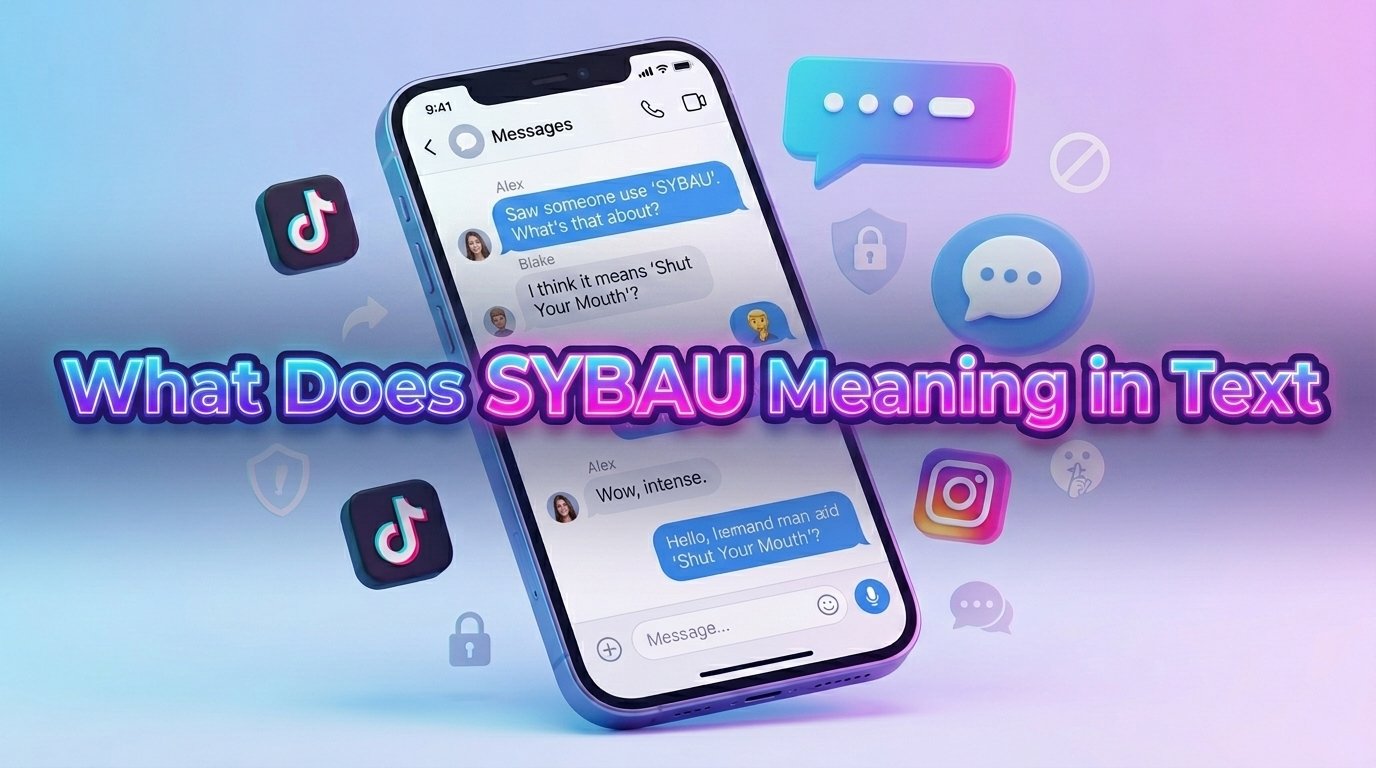
SYBAU stands for:
- “Shut Your B*tch A Up”**
It’s a strong, informal slang phrase used to tell someone to stop talking.
Key Characteristics:
- Emotionally charged
- Often sarcastic or exaggerated
- Can be playful or offensive
Quick Examples:
- “SYBAU 😭 you’re talking too much”
- “Bro SYBAU nobody asked”
- “Just SYBAU for a second and listen”
In short, it’s not neutral—it always carries a tone.
Origin & Background
SYBAU comes from the fast-moving world of internet slang, where exaggeration and emotional intensity are part of the culture.
Its roots can be traced to:
- Online gaming chats
- Meme communities
- Short-form platforms like TikTok
In these environments, communication is often:
- Quick
- Reactive
- Dramatic
Instead of simply saying “be quiet,” users amplify the phrase for effect. That’s how something like SYBAU gained traction—it delivers impact in seconds.
Over time, the meaning evolved in two directions:
- Literal (aggressive): Used in arguments or frustration
- Figurative (playful): Used jokingly among close friends
But even in its “funny” form, the phrase hasn’t lost its sharp edge.
Real-Life Conversations
Understanding SYBAU becomes easier when you see it in real situations.
WhatsApp Chat
Person A: You always tell the same story again and again 😭
Person B: SYBAU I like my stories
Instagram DM
Person A: Why are you always late?
Person B: SYBAU you’re always early for no reason
TikTok Comments
User 1: This doesn’t even make sense
User 2: SYBAU it’s just a joke 💀
Text Message
Person A: Stop overthinking everything
Person B: SYBAU let me think how I want
Each example shows a different tone—from playful teasing to mild irritation.
Emotional & Psychological Meaning
SYBAU is more than just a phrase—it’s an emotional shortcut.
It often expresses:
- Frustration – “You’re getting on my nerves”
- Playful annoyance – “You’re being extra, but I’m joking”
- Defensiveness – reacting to criticism
- Dominance – shutting down a conversation
Why do people use it?
Because it delivers a strong reaction instantly. In digital communication, where attention spans are short, people often rely on bold expressions to get their feelings across quickly.
A real-life scenario:
You’re joking with a close friend who keeps teasing you about something embarrassing. Instead of explaining yourself, you reply:
“SYBAU 😂”
In that moment, it feels like shared humor—not aggression.
But if the same message is sent in a serious discussion, it can feel dismissive or even disrespectful. That’s the psychological layer—tone depends on trust.
Usage in Different Contexts
1. Social Media
On platforms like TikTok and Instagram, SYBAU is often exaggerated for humor.
Example:
“SYBAU this is actually funny 😭”
It’s less about anger and more about dramatic expression.
2. Friends & Relationships
Among close friends, it can feel like inside-joke language.
Example:
“SYBAU you always roasting me 😭”
But even here, boundaries matter. Not everyone is comfortable with aggressive humor.
3. Work / Professional Settings
Avoid SYBAU completely in professional communication.
It can:
- Damage your credibility
- Come across as disrespectful
- Create unnecessary conflict
In formal environments, clarity and respect always come first.
4. Casual vs Serious Tone
- Casual setting: Sometimes acceptable
- Serious conversation: Inappropriate and risky
If someone is sharing something meaningful, using SYBAU can feel like shutting them down emotionally.
When NOT to Use It
There are clear situations where SYBAU doesn’t belong:
- Talking to someone you don’t know well
- Professional or academic conversations
- Emotional or sensitive discussions
- Public comments where tone can be misunderstood
- Cross-cultural interactions
In many cultures, direct or aggressive language—even jokingly—can feel disrespectful.
Common Misunderstandings
1. “It’s always a joke”
Not true. Some people use it seriously, especially during arguments.
2. “Everyone understands it”
Many people don’t recognize the acronym—but they’ll feel the tone if explained.
3. “It’s harmless slang”
It’s not harmless in every context. Tone can quickly shift how it’s received.
4. Literal vs Figurative Meaning
- Literal: Harsh and offensive
- Figurative: Playful teasing among friends
Understanding which one is being used depends entirely on context.
Comparison Table
| Expression | Meaning | Tone | Usage |
| SYBAU | Shut your b**** a** up | Aggressive / playful | Friends, arguments |
| STFU | Shut the f*** up | Direct, harsh | Arguments |
| Chill | Calm down | Soft | Friendly tone |
| Relax | Take it easy | Neutral | Everyday conversation |
| Ignore it | Don’t engage | Calm | Advice |
| Keep going | Opposite of SYBAU | Encouraging | Supportive |
Key Insight
SYBAU sits at the extreme end of texting slang. It’s powerful but unpredictable—what feels funny in one moment can feel offensive in another. Context is everything.
Variations / Types
- SYBAU 😂 – Adds humor, softens tone
- SYBAU fr – “For real,” more serious
- SYBAU bro – Casual, friendly context
- SYBAU pls – Sarcastic tone
- SYBAU rn – “Right now,” adds urgency
- SYBAU lol – Turns it into a joke
- SYBAU man – Conversational style
- SYBAU respectfully – Ironic, often sarcastic
- SYBAU ngl – Honest but blunt tone
- SYBAU 💀 – Meme-style exaggeration
How to Respond When Someone Uses It
Casual Replies
- “Alright, I’ll chill 😂”
- “Okay okay, I’m done”
Funny Replies
- “Make me 😭”
- “You wish 😂”
Mature Replies
- “No need to be harsh, let’s talk normally.”
- “If something’s bothering you, just say it.”
Respectful Replies
- “I’d appreciate a more respectful tone.”
- “Let’s keep things positive.”
Regional & Cultural Usage
Western Culture
More commonly used, especially in meme and gaming communities. Often sarcastic.
Asian Culture
Less direct communication style. Strong phrases are usually softened, so SYBAU may feel too harsh.
Middle Eastern Culture
Respect and tone are important. Such phrases can easily be seen as disrespectful unless used among very close friends.
Global Internet Usage
Popular among younger audiences across platforms like TikTok, Discord, and Instagram.
Generational Differences
- Gen Z: Uses it casually, often humor-driven
- Millennials: Understand it but may avoid using it
- Older generations: Likely to see it as rude or inappropriate
Is It Safe for Kids?
Not really.
While it’s abbreviated, the full phrase behind SYBAU is aggressive and not suitable for polite communication. Younger users may use it without understanding its impact.
Guidance and context awareness are important.
Discover More Post
- EYP Meaning: What It Really Means in Texts, Chat, TikTok, and Relationships
- TTYL Meaning: What It Really Means in Texts, Chats, and Social Media
- YW Meaning: What It Really Means in Texts, Social Media, and Everyday Conversations
- MB Meaning: What It Really Means in Texts, Chats, Social Media, and Everyday Communication
FAQs
1. What does SYBAU mean in text?
It means “Shut Your B*tch A** Up,” a strong and often offensive slang phrase.
Is SYBAU rude?
It can be. Tone and relationship determine whether it feels playful or offensive.
Can I use SYBAU jokingly?
Yes, but only with people who understand your humor well
Is SYBAU worse than STFU?
They are similar, but SYBAU can feel more personal
Why do people use SYBAU?
To express strong emotions quickly, often with humor or exaggeration.
Should I use SYBAU in public comments?
It’s better to avoid it—it can easily be misunderstood.
How should I react if someone uses it?
Stay calm, read the context, and respond based on tone.
Conclusion
SYBAU is one of those slang terms that shows how powerful—and risky—modern communication can be. It’s quick, expressive, and emotionally charged, but that same intensity makes it easy to misinterpret.
Used among close friends, it can feel like playful banter. Used in the wrong moment, it can shut down a conversation or create unnecessary tension.
The real skill isn’t just knowing what SYBAU means—it’s knowing when it fits and when it doesn’t.
Read the room, understand the relationship, and you’ll navigate it confidently without losing your tone or respect.